Pomegranate is one of India's strongest export crops, and also one of the most demanding to grade by hand. Export buyers reject fruit over small inconsistencies in skin colour, size and surface defects that a tired worker can easily miss on the thousandth piece of the day. A pomegranate grading machine built on AI and computer vision catches what manual sorting cannot, at the exact point where a rejected container costs the most.
Where India's pomegranates come from
Maharashtra is India's largest pomegranate producing state by far, with Solapur, Sangli, Nashik and Ahmednagar forming the core belt — Solapur in particular is often called the country's pomegranate capital. Karnataka follows, centred around Bagalkot and Vijayapura, with Gujarat and Rajasthan also recognised among the country's leading pomegranate producing states, and parts of Andhra Pradesh and Telangana contributing a smaller but growing share. Export volumes to the Middle East, Bangladesh and Europe are concentrated largely in the Maharashtra belt, which is exactly why grading consistency matters more here than for most other fruit.
India's pomegranate market, in numbers
India is the world's largest producer of pomegranate, and Maharashtra alone accounts for roughly two thirds of the country's growing area. On the export side, India shipped 72,011 metric tonnes of pomegranate worth USD 69.08 million in FY2023-24, with the UAE, Bangladesh, Nepal, the Netherlands, Saudi Arabia, Sri Lanka, Thailand, Bahrain and Oman as the leading destinations. Market access is also widening: Australia opened its market to Indian pomegranate in 2020, and the first commercial shipment, grown and packed in Maharashtra, reached Melbourne in August 2024. Every one of those markets grades on the same things an AI system checks automatically — size, skin colour and surface defects — which is exactly where consistent grading at the packhouse turns into fewer rejected shipments and better prices.
Why manual pomegranate grading falls short
Pomegranate grading depends on judging size, skin colour and the presence of surface blemishes, cracks or sunburn, all by eye. Two workers grading the same lot will disagree on borderline fruit, and the same worker's judgement drifts over a long shift. For export lots, that inconsistency is expensive: a container flagged for mixed grading at the destination port can mean a rejected shipment, not just a lower price. Manual handling also increases the risk of fruit damage — pomegranate skin bruises and cracks easily, and a few mishandled pieces lower the grade of the whole batch.
What an AI pomegranate grading machine actually does
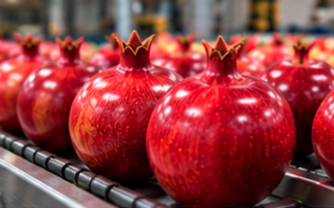
A pomegranate sorting machine using computer vision scans each fruit and grades it by size, skin colour, external defects and surface damage, in a fraction of a second per piece. The system applies the same criteria to the first fruit and the ten thousandth, which is the consistency export buyers actually require. The output is a lot sorted into clear, buyer-ready grades, with a digital quality record attached to each batch — useful when a buyer or certifier asks for grading evidence.
The benefits, for growers, packhouses and exporters
- Right pricing for farmers. Grade-based sorting means export-quality pomegranates are identified and priced as export quality, instead of being averaged down with a mixed lot.
- Lower wastage and fewer rejected shipments. Catching cracked, sunburned or undersized fruit before packing reduces the risk of a container being downgraded or rejected at the destination.
- Better and more consistent quality. Uniform grading builds trust with export buyers and large retail chains, who pay a premium for shipments that match their stated specification every time.
- Disease and defect control. Computer vision flags fungal spotting and skin damage that is easy to miss in high-volume manual sorting, before affected fruit reaches a mixed lot.
- Faster processing. Export packing runs on tight shipping windows, and a machine that grades in minutes instead of hours matters when a container has to be loaded on schedule.
Who uses Intello Labs pomegranate grading machines
Retailers, packers, exporters, importers, packhouses, aggregators and farmers all rely on Intello Labs grading systems to meet export specifications and get paid fairly for the quality they actually produce. Intello Labs currently has more than 100 AI sorting and grading machines deployed across India, working across pomegranate and multiple other commodities, from export packhouses in Maharashtra to quick commerce dark stores.
See it in action
Book a demo
See a pomegranate grading machine working on your own fruit. Book a demo with the Intello Labs team, or get in touch through intellolabs.com to speak with someone directly.
Related reading
AI pomegranate grading machine (solutions overview) · Intello FruitSort on the products page · Apple sorting and grading in India